The Hasanpaşa Gas Plant: An Industrial Icon of Kadıköy in a New Role
The Hasanpaşa Gas Plant (Turkish: Hasanpaşa Gazhanesi, now Müze Gazhane) is a rare example in Istanbul of how a drab 19th-century industrial building has been transformed into a vibrant 21st-century cultural district. The old Ottoman factory, which illuminated the Anatolian side of the metropolis for over a century, is now filled with the voices of children at the science center, the buzz of theater rehearsals, and the aroma of coffee from the courtyard café. The Hasanpaşa Gas Plant is located in the Kadıköy district at 125 Kurbağalıdere Street, and since its opening on July 9, 2021, it has become perhaps the most unexpected museum venue on the Asian side of the city—a place people visit not for “classic” Istanbul, but for its industrial heritage and vibrant contemporary culture.
History and Origins of the Hasanpaşa Gas Plant
In the mid-19th century, the Anatolian side of Istanbul was lit by the Kuzgunçuk Gas Plant, built as early as the 1860s. By the end of the century, its capacity was no longer sufficient: Kadıköy and Üsküdar were growing rapidly, and the Ottoman Empire began considering a new, large-scale gas plant. The decision was finalized on July 28, 1891: the state granted a 50-year concession to the joint-stock company “Gas and Electricity Lighting” to supply the districts of Kadıköy, Üsküdar, and the entire Anatolian coast—all the way to the borders of Beykoz. The agreement was signed by engineer Anatoli Barsil, representing the Parisian metallurgical industrialist Charles Georges, and Shehremini Ridvan Pasha on behalf of the empire.
Construction began on August 1, 1891, under the supervision of architect-contractor Guglielmo Semprini. The site was chosen near the Kurbagalidere stream: coal was transported by water and then delivered directly to the workshops via a specially laid railway. As early as 1892, the plant began operations under the name “Üsküdar-Kadıköy Gaz Şirket-i Tenviriyesi” and became the city’s fourth gas facility—alongside Dolmabahçe, Edikule, and Kuzgunçuk. At first, it was called Kurbagalidere or the Kadıköy Gas Plant; its current name—derived from the neighboring Hasanpaşa district—took hold later, in the everyday speech of the townspeople themselves. For a Russian-speaking traveler, gas lighting itself was a detail straight out of the Dickensian era: around the same time, gas lamps were being lit on Nevsky Prospect in St. Petersburg and in the Zamoskvorechye neighborhoods, and Istanbul unexpectedly found itself on par with European capitals in terms of technology.
The plant operated almost nonstop until World War I. When coal became scarce, olive pits were burned in the furnaces—just so the city would not be left without light and heat. In October 1924, a year after the proclamation of the republic, the concession was extended for another half-century: the document was signed by Mayor Emin Bey and company board member Arif Hikmet Bey. In 1926, the enterprise was acquired by the firm managing Yedikule, consolidating the assets into “Istanbul Havagazı ve Elektrik Teşebbüsatı Sanaiye Türk Anonim Şirketi.” From 1938 to 1944, the Kadıköy plant was once again independent, and from 1945 to 1993, it was part of the İETT municipal transport holding company. On June 13, 1993, following the widespread introduction of natural gas in the city, the furnaces were extinguished forever—marking the end of the plant’s 101-year industrial era. For the first time in a century, the sky above Kadıköy cleared of its characteristic haze, and city residents, accustomed to checking the time by the factory’s whistles, continued to glance reflexively in its direction for a long time afterward.
Architecture and What to See
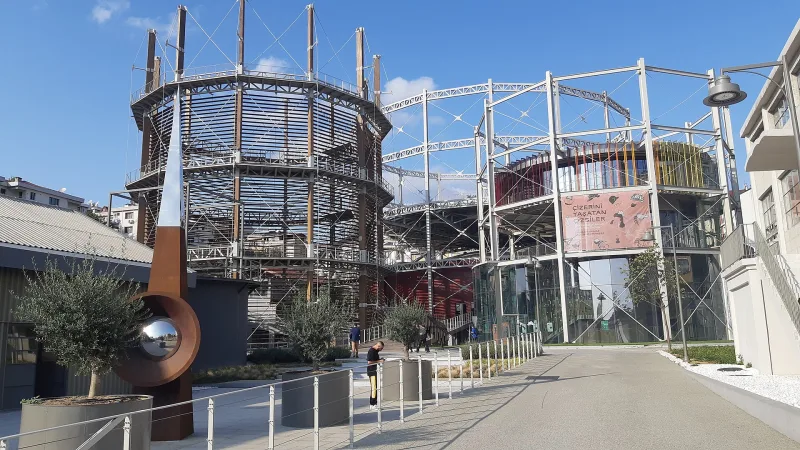
Müze Gazhane occupies an area of about 30,000 m²—it is an entire industrial quarter of brick buildings, gas holders, and metal trusses, framed by green lawns. The main architectural impression here is contrast: rough, soot-stained 19th-century masonry stands alongside the mirrored glass inserts from the 2010s restoration. The renovation was led by a team from the Faculty of Architecture at Istanbul Technical University (İTÜ) under the academic supervision of Professor Afife Batur; with Gülsün Taneli and Kani Kuzuldular serving as project curators. The restoration took place from March 7, 2014, through 2021—two years behind the original schedule.
The gas holder buildings and the science center
The former coal gas tanks are the most recognizable structures in the complex. One of them houses a science and technology museum with interactive exhibits for children and teenagers: installations on physics, engineering, and optics, as well as hands-on experiments. The complex also houses a climate museum—a relatively new concept for Turkey, dedicated to climate change and ecology—and a cartoon museum, a favorite among Istanbulites of all ages. Walking between the cylindrical structures, it’s easy to imagine workers in woolen caps coming in here, with steam rising from the tank vents. The black metal roof trusses, rivets, and guide rails—all of this has been preserved in its original form, with only the load-bearing elements reinforced.
The Afife Batur Library
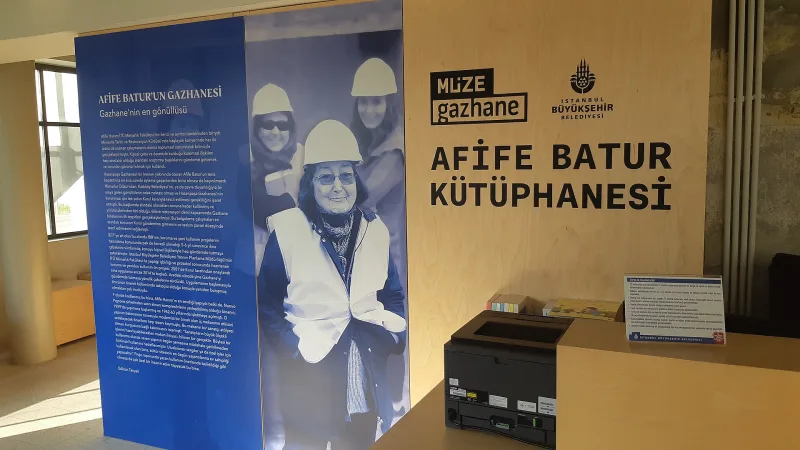
One of the renovated workshops has been transformed into a spacious library named after the head of the restoration project, Professor Afife Batur. The collection includes about 10,000 books on architecture, art, urban history, and cultural heritage. High trusses, long wooden tables, and soft overhead lighting make this one of the most atmospheric places to work and read in Kadıköy, and locals appreciate it just as much as visitors. A reading room with rare editions on the history of Istanbul’s industry is open to researchers.
Theater Stages — “Grand” and “Square”
Müze Gazhane houses two stages of the Istanbul City Theater. The 301-seat main hall was named in 2022 after theater scholar Sevda Şener; the first production staged there was Albert Camus’s *The Plague*, directed by Neil Bartlett—a choice that resonated particularly strongly in the wake of the pandemic years. The 130-seat chamber hall is called “Meydan Sahne” (“Square Stage”); it hosted the debut of Lot Vekemans’ play “Poison.” The program is updated almost weekly, and some performances feature Turkish subtitles, while others have English subtitles.
Open Space and Gastronomy
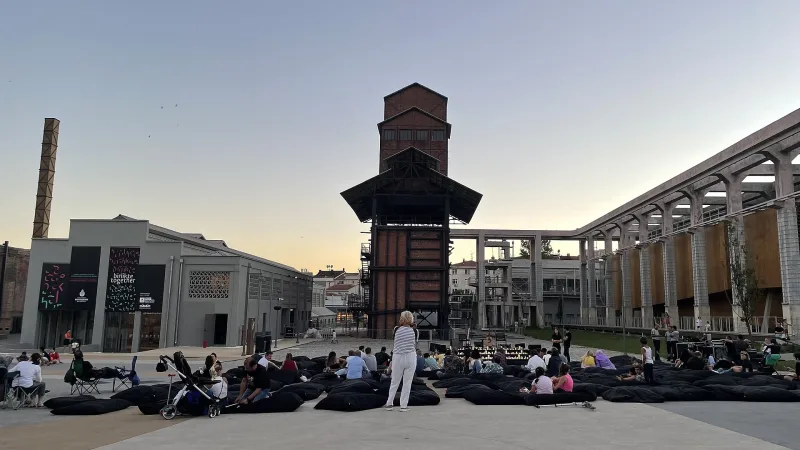
A park with lawns, benches, and areas for street concerts is laid out between the buildings. Along the perimeter are a café, a restaurant, a pastry shop, and a bookstore. During the warmer months, the area hosts farmers’ markets, design fairs, and open-air film screenings. This is a rare green space in the heart of Kadıköy, and local families come here with their children and dogs just to take a walk—especially at sunset, when the reddish light falls on the old brickwork.
Interesting Facts and Legends: The Hasanpaşa Gas Plant
- During the coal shortages of World War I, olive pits were burned here—an old urban legend claims that Kadıköy residents could tell from the smell coming from the chimneys what the harvest was like that season in the Aegean olive groves.
- After its closure in 1993, the site was used as a warehouse, garage, dump, and coal storage facility. In 1994, the municipality ordered the demolition of the remaining structures, but the demolition was halted by resistance from residents and NGOs—a rare instance where grassroots civic activism saved an industrial landmark of Istanbul.
- The civic initiative “Gazhane Çevre Gönüllüleri” (“Gazhane Environmental Volunteers”) was formed in 1996 and became a cooperative in 1998. By 2009, activists had held eight free festivals on the site featuring concerts, exhibitions, and theater, effectively laying the groundwork for the site’s future cultural role.
- The restoration project was developed at İTÜ from 1998 to 2001 but was not approved until 2014. Work began on March 7, 2014, and was supposed to be completed by 2019, but the opening took place only on July 9, 2021—a two-year delay typical of major restoration projects in historic Istanbul.
- Architect Guglielmo Semprini, who began construction on August 1, 1891, was an Italian contractor, as were many specialists in late 19th-century Ottoman Istanbul: at that time, the city was full of Levantine engineers, and Kadıköy was generally considered the empire’s “European suburb.”
- The theater stages bear symbolic names: since 2022, the “Main Stage” has been named in honor of theater scholar Sevda Şener—her name was officially unveiled on May 9, 2022, exactly one year after the hall opened, which in Turkish theater is considered a gesture of recognition for an entire school of dramaturgy.
How to get there
Müze Gazhane is located in the Kadıköy district, at 125 Kurbağalıdere Street, just a 15–20-minute walk from the famous Kadıköy ferry terminal. For Russian-speaking tourists, the most picturesque route is by ferry from Karaköy, Eminönü, or Beşiktaş: the crossing over the Bosphorus takes about 20 minutes and is a mini-tour in itself, especially at sunset, when the silhouette of the Old City is bathed in a pink-gold light. From the Kadıköy pier, you can walk along the waterfront and into the neighborhood, past the Kadıköy Market and the Moda district, or take a taxi—the ride is inexpensive and takes 5–7 minutes without traffic.
Alternatively, the M4 metro line (Kadıköy–Sabiha Gökçen) leads to Müze Gazhane. Convenient stops are Kadıköy and Ayrılık Çeşmesi; the latter intersects with the Marmaray suburban railway, which is convenient for visitors coming from the European side. From Sabiha Gökçen Airport (SAW), you can take the M4 directly in about 40 minutes—this is the fastest and most affordable option. From Istanbul Airport (IST), the most convenient way is to take the M11 metro to Gayrettepe, then transfer to the M2 and Marmaray to Söğütlüçeşme station—from there, it’s a 10-minute walk to the museum. On Google and Yandex Maps, the location is easily found by searching for “Müze Gazhane” or “Hasanpaşa Gazhanesi.”
Tips for travelers
The best time to visit is spring (April–May) and fall (September–October): during these months, it’s pleasant to stroll through the complex’s courtyard for hours, open-air events take place, and the theater season is in full swing. In summer, it’s coolest inside the buildings with thick brick walls—a welcome respite from Istanbul’s heat. In winter, plan your visit for daytime hours and buy a theater ticket right away: evenings in Kadıköy can be damp and windy.
Allow at least 1.5–2 hours for a tour, and half a day if you plan to attend a theater performance or workshop. Admission to the grounds and most exhibitions is free, but certain educational programs and performances require a ticket—it’s best to check the schedule in advance on the official website of the Istanbul Municipality and the websites of the city’s theaters. For families with children, weekday mornings are ideal, when there are no school groups at the science center.
Combine your visit with a stroll through the neighboring neighborhoods of Kadıköy: Kadıköy Market with its fish stalls and cheese shops, Bahariye pedestrian street, the bohemian Moda district with its panoramic view of the Princes’ Islands, and the old railway line converted into a green promenade—all within a 20–30-minute walk. Before leaving, stop by the café on the museum grounds and try some Turkish tea in a glass cup while gazing at the old gasometers: The Hasanpaşa Gasworks is a place where the city’s industrial heritage has been transformed into a vibrant cultural hub, and it is precisely for this experience that it is worth making the trip to the Asian shore.